Real-Life Water Recirculation System for Engineering Education
Fluid mechanics is a core subject in engineering, and pumps play a vital role across countless industries. That is why many universities and colleges install live pumping stations in their engineering laboratories, giving apprentice engineers the chance to gain at least basic pump training.
One of the UK’s leading engineering colleges contacted us with a requirement for two centrifugal pumps for a training facility in the north-west of England. The aim was to create a real-life water recirculation system with a standby arrangement, allowing students to observe the pumps in operation and better understand liquid behaviour and flow velocity under different pressures and operating speeds.
The college also wanted engineering students to be able to dismantle and reassemble the pumps, so they could become familiar with all the internal mechanical components. Because of the nature of the application, the units needed to be long coupled. This would allow students to see how the pump and motor shafts are joined together by the coupling, while also making the pumps quicker to disassemble.
Since the pumps would be operated at different speeds, flow rates and pressures, there was a strong likelihood that they would sometimes run near their limits. Although intended only for educational purposes, the pumps therefore had to be robust enough to avoid failure or premature wear.
Supply of Two Easy-to-Maintain Horizontal Long-Coupled Centrifugal Pumps and Wearing Parts
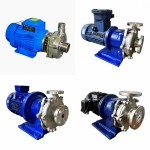
We supplied two of our horizontal long-coupled centrifugal pumps, complete with 2.2 kW ABB motors. The supplied units are capable of delivering 11 m³/h at 22 metres of head. We also provided a set of spare mechanical seals, gaskets and bearings, so the college could replace components if wear occurred.
These pumps were the ideal solution for the customer because of their long-coupled design. The operator can access the components inside the pump head without having to remove the motor. In addition, the back pull-out design allows the motor to be removed while the wet end remains connected to the pipework.
Our long-coupled, single-stage centrifugal pumps is designed to handle clean or moderately dirty low-viscosity fluids. The range complies with DIN 24255 standards, making it dimensionally interchangeable with many of the most common models. This allows customers to replace existing older pumps without needing to modify pipework. The range is available in a wide variety of sizes and configurations, with the largest model capable of producing a maximum flow rate of 600 m³/h. ATEX explosion-proof versions are also available on request.
Conclusion
This project demonstrates how robust, serviceable centrifugal pumps can support engineering education. By providing students with a real-life recirculation system, the college gives them practical exposure to pump hydraulics, maintenance and system design—helping to bridge the gap between classroom theory and real-world engineering.