Know Your Pumps: A Guide to Common Pump Types
Selecting the right pump for your application can feel daunting—there are so many types, designs, and features to consider. From magnetic drive pumps to lined pumps and canned motor pumps, each option has its own strengths and ideal uses. In this post, we explain some of the most common types of industrial pumps and what makes each one distinctive.
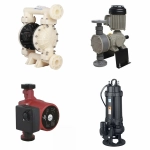
Air Operated Double Diaphragm Pumps (AODD Pumps)
An AODD pump is a positive displacement pump that runs on compressed air rather than an electric motor. It uses two flexible diaphragms connected by a shaft, which move back and forth to create suction and discharge cycles.
As compressed air enters one chamber, it pushes the diaphragm outward, forcing fluid out of that side while simultaneously drawing fluid into the opposite chamber. A set of check valves ensures that liquid flows in only one direction. The air supply then shifts to the other chamber, repeating the cycle and maintaining a steady flow.
AODD pumps are self-priming, can run dry without damage, and handle abrasive, viscous, or shear-sensitive fluids. This makes them suitable for industries such as chemical processing, wastewater treatment, food and beverage, and mining. Their sealless design reduces the risk of leaks, and they are commonly used in hazardous or explosive environments where electric pumps are not suitable.
ANSI Mag Pumps
An ANSI mag pump is a magnetic drive pump that follows the ANSI (American National Standards Institute) B73.3 specification for chemical process pumps. The ANSI standard defines the pump’s dimensions, design, and construction features to ensure interchangeability and compatibility with other ANSI pumps, making it easier to replace or retrofit pumps in a system.
The magnetic drive feature means the pump operates without a traditional shaft seal. Instead, the motor and pump are coupled through magnets, eliminating the possibility of leakage. The absence of mechanical seals also reduces maintenance requirements and improves safety by preventing leaks of dangerous chemicals.
Canned Motor Pumps
A canned motor pump is a sealless, leak-free pump designed for hazardous, corrosive, or valuable fluids. It features an integrated motor and pump unit enclosed within a hermetically sealed “can.”
Inside the pump, the rotor is fully submerged in the pumped fluid, which acts as both a lubricant and a coolant for the motor. This results in low maintenance, increased safety, and a compact design. Canned motor pumps are commonly used in chemical processing, oil and gas, and pharmaceutical industries, where fluid containment and operational efficiency are critical.
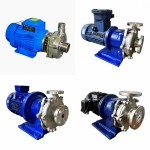
Centrifugal Pumps
A centrifugal pump uses a rotating impeller to move fluid by converting mechanical energy into kinetic energy. As the impeller spins, it creates centrifugal force that pushes the fluid outward, increasing its velocity. This high-velocity fluid is then directed through a diffuser or volute casing, where velocity is converted into pressure, allowing the fluid to be transported efficiently through piping systems.
Centrifugal pumps are widely used in water supply, chemical processing, HVAC, and industrial applications due to their simple design, high efficiency, and ability to handle large flow rates. They work best with low-viscosity liquids and can be engineered for a variety of applications, including single-stage, multistage, and specialised designs such as magnetic drive or canned motor pumps.
Gear Pumps
A gear pump is a type of positive displacement pump that uses rotating gears to move fluid. As the gears turn, liquid is trapped between the gear teeth and the pump casing and pushed from the inlet to the outlet. Gear pumps are known for delivering a consistent, pulseless flow, making them ideal for handling oils, fuels, and other viscous liquids.
ISO Process Pumps
An ISO process pump is designed and built to meet the specifications outlined in ISO 13709 (formerly ISO 2858), a standard that governs the design, performance, and dimensions of pumps used in industrial process applications. These pumps are typically used in sectors where high reliability and standardised equipment are essential.
They are usually designed with features such as mechanical seals, flanged connections, and robust materials to ensure leak-free operation and durability.
Lined Pumps
A lined pump is designed to handle highly corrosive, aggressive, or hazardous fluids and chemicals. Instead of being made entirely from expensive corrosion-resistant metals, it features an internal lining made from materials such as PTFE or PFA. This protects the pump’s metal casing and ensures durability and reliability in harsh environments.
Liquid Ring Vacuum Pumps
A liquid ring vacuum pump is a type of rotary positive displacement pump used to create a vacuum using a rotating impeller and a sealing liquid. As the impeller spins, centrifugal force pushes the liquid outward, forming a ring of liquid inside the pump casing. This creates sealed compression chambers between the impeller blades, trapping and compressing gas before exhausting it.
These pumps offer smooth, continuous operation with minimal vibration and noise. Their self-lubricating nature also makes them a low-maintenance alternative to dry or oil-sealed vacuum pumps.
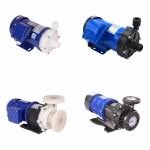
Magnetic Drive Pumps
A magnetically driven pump uses a magnetic coupling to transmit power from the motor to the impeller. Unlike traditional pumps that use a direct drive shaft, a mag drive eliminates the need for a mechanical seal. A mechanical seal relies on a film of liquid covering the seal faces, which increases the chance of leakage. The magnetic coupling allows the pump to operate without any physical contact between the driving and driven components, resulting in a hermetically sealed and leak-free design.
Mechanically Sealed Pumps
This type of pump uses a mechanical seal to prevent fluid leakage where the pump shaft passes through the casing. The mechanical seal consists of two flat, precision-machined surfaces—one rotating with the shaft and the other stationary—pressed together by a spring or hydraulic force to create a tight seal. A thin film of fluid between these faces provides lubrication and helps prevent wear.
Peristaltic Pumps
A peristaltic pump is a type of positive displacement pump that moves fluid through a flexible tube by compressing and releasing it in a rhythmic motion. The pump operates using a set of rollers that rotate around a central hub, squeezing the tube to create a continuous flow. Once the rollers release the tube, it returns to its original shape, drawing in more fluid due to the vacuum effect.
These pumps are ideal for handling abrasive, corrosive, or shear-sensitive fluids, because the liquid only contacts the inner surface of the tubing, reducing contamination and maintenance. Their self-priming capability and ability to run dry without damage also make them versatile for various pumping applications.
Peristaltic Hose Pumps
Peristaltic hose pumps work in a way similar to squeezing toothpaste out of a tube. They use rollers that compress a flexible hose, pushing the fluid along in a controlled manner. Because the liquid only touches the inside of the hose, these pumps are perfect for abrasive, corrosive, or hygienic applications. They are easy to maintain—simply change the hose—and their gentle pumping action makes them suitable for delicate fluids.
Peripheral Turbine Pumps
A peripheral turbine pump, also known as a regenerative turbine pump, is a type of centrifugal pump designed for low-flow, high-head applications. It features a uniquely designed impeller with multiple small blades or vanes that pass through a narrow channel in the pump casing. As fluid moves through this channel, it is repeatedly accelerated and recirculated, increasing its pressure in a process known as regeneration.
These pumps offer higher pressure capabilities than standard centrifugal pumps of similar size, making them a compact and efficient choice for systems requiring consistent, high-pressure fluid delivery.
Pneumatic Pumps
A pneumatic pump is operated by compressed gas or air, such as an air operated double diaphragm pump. Pneumatic pumps can have a lower initial capital cost, but because producing compressed air can be quite costly, the whole-life operating costs of the pump should be considered.
Positive Displacement Pumps
A positive displacement pump moves fluid by trapping a fixed amount of liquid and forcing it through the discharge. Unlike centrifugal pumps, which rely on velocity and pressure conversion, positive displacement pumps deliver a constant flow regardless of pressure changes. This makes them ideal for applications requiring precise flow control and the handling of viscous or sensitive fluids. Their ability to handle high pressures, thick fluids, and delicate materials makes them essential in industries where accurate and consistent fluid movement is critical.