A Complete Guide to Magnetic Drive Pumps
Contents
Introduction and the Basics – What is a magnetic drive pump? How does a mag drive pump work? What are its key components?
Different Types and Variations of Mag Drive Pumps
Performance and Capabilities – Plus the Advantages of Plastic Pumps, Typical Applications, and Industries
Operational Considerations – Can They Run Dry? Common Failures and How to Prevent Them
Introduction and the Basics
What Is a Magnetic Drive Pump?
A magnetically driven pump—commonly known as a mag drive pump—uses a magnetic coupling to transmit power from the motor to the impeller. Unlike conventional pumps that rely on a direct drive shaft, a mag drive removes the need for a mechanical seal. A mechanical seal depends on a thin film of liquid covering the seal faces, which increases the possibility of leakage.
The magnetic coupling allows the pump to operate without any physical contact between the driving and driven parts. The result is a hermetically sealed, leak-free design.
How Does a Mag Drive Pump Work?
A magnetic drive pump functions in much the same way as any other centrifugal pump. Fluid enters the pump inlet, flows into the eye of the impeller, exits at the outer diameter, and is directed through the volute to the pump outlet.
The difference lies in how the impeller is driven. Instead of being directly coupled to the motor, the impeller is turned by two magnets. As the motor shaft rotates the drive magnet, the inner magnet and impeller rotate with it. Because the fluid is completely enclosed, there is no need for a mechanical seal, and the pump can operate without the risk of leaking potentially harmful liquids.
Key Components of a Mag Drive Pump
Outer (drive) magnet assembly – Connected to the motor shaft, it transfers torque through the containment shell without physical contact.
Inner magnet assembly – Mounted on the impeller inside the pump; it rotates in sync with the drive magnet to move the fluid.
Containment shell – A non-magnetic barrier that fully seals the liquid chamber. Depending on the range, materials include reinforced plastic such as PP or ETFE, or metallic shells with PFA lining.
Impeller – Hydraulically optimised to generate flow and pressure. Mag drive pump designs include high-efficiency geometries and optional reinforced or ETFE-lined versions built for aggressive chemicals.
Pump casing / volute – Houses the impeller and directs the flow. Crest offers solid plastic casings or metallic casings with corrosion-resistant linings.
Bearings and shaft support system – Typically made from ceramic, carbon, silicon carbide, or combinations depending on the chemical and duty. The Crest Assoma AMXi and AME ranges include enhanced bearing protection and axial/radial load balancing features.
Auxiliary cooling/lubrication channels – Used to circulate process fluid to cool and lubricate the internal bearings.
Motor (or canned motor assembly)
Different Types and Variations of Mag Drive Pumps
Magnetic drive pumps are available in several configurations, each designed to meet specific industrial requirements, fluids, and installation environments. The most common types include:
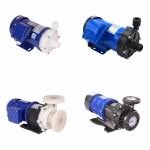
Horizontal centrifugal mag drive pumps – The most common type. They are ideal for general chemical transfer and recirculation, as well as highly corrosive, heavy-duty applications. They feature a horizontal shaft and are available in both plastic and metallic-lined designs.
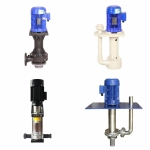
Vertical sump / vertical inline mag drives – Designed for installations with limited floor space, or where the pump needs to sit above a tank. The motor remains outside the liquid while the pump end is submerged. They are ideal for corrosive sumps, etching baths, and clean-in-place (CIP) systems.
Canned motor mag drive pumps – Instead of a traditional motor and magnetic coupling, canned motor pumps combine the motor and pump into one hermetically sealed unit, offering quiet, efficient, and leak-free operation.
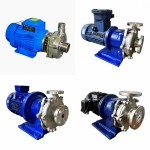
Metallic and lined magnetic drive pumps – These pumps use metal casings, often stainless steel or ductile iron, lined with corrosion-resistant materials such as PFA or ETFE. They are ideal for high-temperature or high-pressure applications where plastic pumps are not suitable.
Plastic magnetic drive pumps – Built entirely from corrosion-resistant plastics such as polypropylene or ETFE for maximum chemical compatibility. They are lightweight, cost-effective, and widely used in the chemical and wastewater treatment industries.
ANSI mag drive pumps – ANSI or ISO pumps comply with international dimensional standards. Crest Pumps can now exclusively offer the USA-made Truflo TNP ANSI mag drive. The TNP range uses a ductile iron casing lined with a fluoropolymer. This combination provides the mechanical strength of metal with the corrosion resistance of a non-metallic lining.
Performance and Capabilities
Mag drive pumps are engineered to deliver reliable, leak-free performance across a broad range of industrial applications. Their hydraulics mirror those of standard centrifugal pumps, but their sealless magnetic coupling enables continuous operation with minimal maintenance and exceptional chemical resistance.
Depending on the materials of construction—such as polypropylene, ETFE, PFA-lined metals, or high-grade ceramics—mag drives can safely handle highly corrosive acids, alkalis, plating solutions, solvents, and ultra-pure process fluids. They perform best with clean, low-viscosity liquids. However, upgraded designs with reinforced bearings and internal cooling can tolerate high temperatures, trace solids, and demanding duty cycles. Plastic mag drives usually operate comfortably up to 80–95°C, while metallic or PFA-lined models can extend well above this range.
One of the main advantages is their leak-free operation. By eliminating mechanical seals—the most common failure point in conventional pumps—mag drives offer excellent containment for hazardous or environmentally sensitive fluids. This makes them suitable for industries where contamination control is essential.
With correct sizing and installation, mag drive pumps offer long service life, low running costs, and consistent, dependable performance.
Advantages of Using Plastic
Traditionally, engineers selecting pumps for corrosive liquids had to choose between pumps made from high nickel content alloys such as Hastelloy, or pumps lined with ceramic or glass. Over the last 50 years, however, plastics have advanced considerably and are now readily available in bar form up to 500 mm in diameter for polypropylene, PVC, PVDF, and polyethylene.
The advantages of plastic pumps are numerous:
They are less expensive to manufacture, meaning lower prices for the customer.
They offer faster lead times.
They provide better corrosion resistance, giving the pump a longer life.
They are lighter in weight, offering greater manoeuvrability.
Typical Applications and Industries
Chemical processing – Transfer of corrosive acids and alkalis, chemical dosing, solvent handling and circulation, reactor feed and recirculation.
Water and wastewater treatment – pH correction systems, chemical recirculation in scrubbers and neutralisation tanks, polymer transfer, sodium hypochlorite, caustic and acid dosing.
Metal finishing and surface treatment – Electroplating and anodising line circulation, pickling, stripping and cleaning baths, hot acid transfer, fume scrubber recirculation loops.
Pharmaceutical and biotechnology – High-purity chemical transfer, CIP chemical circulation, and applications requiring hermetic sealing to protect clean environments.
Semiconductor and electronics manufacturing – Handling of aggressive fluoride-based or oxidising solutions, low-contamination recirculation systems, and ultra-pure chemical transfer such as etchants, developers, and rinses.
Food and beverage – CIP acid and caustic circulation, chemical dosing.
Plastic, composites, and resin production – Solvent circulation, high-temperature or viscous chemical duties, transfer of corrosive catalysts and additives.
Environmental and air pollution control – Wet scrubber circulation loops, odour control chemical systems, effluent treatment and neutralisation.
Power generation and renewable energy – Battery chemical handling, cooling circuit chemical dosing, fuel cell and hydrogen-related chemical transfer.
General industrial manufacturing – Safe transfer of hazardous chemicals and leak-free pumping in sensitive production areas.
Across all these sectors, magnetic drive pumps provide a cost-effective, low-maintenance solution that enhances safety, reduces downtime, and delivers consistent performance.
Operational Considerations
Can They Run Dry?
Unfortunately, process errors can occur that cause a pump to run dry. For a mechanically sealed pump, this can cause almost immediate seal failure. Some mag drive pumps are now available with special material bearings to prevent the onset of damage from running dry. However, Crest Assoma mag drive pumps go a step further with a patented circulation path for additional cooling.
Under normal operating conditions, the pumped liquid acts as lubrication between the rotating and stationary parts, and the heat generated by rotation is gently carried away by the circulating liquid. When a pump is starved of liquid, however, these moving parts generate heat from friction, and as heat builds up, damage will occur.
With the Crest Assoma mag drive range, a patented auxiliary circulation channel runs between the bearing and the magnet capsule. The pressure difference creates a convection effect that cools both the interior and exterior of the bearing, preventing the high-temperature build-up caused by dry running. Crucially, while the design allows for increased cooling, there is no reduction in pump efficiency.
It must be pointed out that there are many ways to run a pump dry, and this design feature is in no way a failsafe method. Any pump manufacturer that makes such a claim should be questioned. How long the Crest Assoma mag drive range will run without damage depends on how the pump is run dry—for example, a completely closed inlet valve, an air lock, or foot valve failure—and for how long.
Common Failures and How to Prevent Them
Dry Running – This occurs when there is no liquid inside the pump, so the internal bearings overheat and wear out quickly.
How to prevent it:
Make sure the pump is primed before starting.
Fit level switches, flow switches, or power monitors.
Use pump designs with improved bearing cooling.
Cavitation – This occurs when insufficient suction pressure causes bubbles to form and collapse inside the pump, damaging the impeller.
How to prevent it:
Keep suction pipework short, straight, and oversized.
Avoid clogged strainers or tight valves.
Install the pump close to the liquid level when possible.
Magnet Decoupling (Magnet Slip) – The inner magnet stops turning because the pump is overloaded, while the outer magnet keeps spinning.
How to prevent it:
Do not run the pump with the discharge valve fully closed.
Choose a pump with magnets strong enough for your duty.
Use power monitors to catch overloads early.
Bearing Wear – Bearings wear out faster when the fluid contains solids, gets too hot, or does not flow properly.
How to prevent it:
Use strainers if the fluid contains grit or solids.
Keep liquid flowing through the pump at all times.
Select the right bearing materials for your chemical and temperature.
Chemical Attack or Temperature Damage – This happens when pump materials weaken or deform because the liquid is incompatible or too hot.
How to prevent it:
Check chemical compatibility before choosing materials.
Stay within the pump’s temperature limits.
Avoid sudden temperature changes on plastic pumps.
Blocked Cooling Channels – The small internal passages that cool and lubricate the bearings become blocked, causing overheating.
How to prevent it:
Filter out crystals or solids that may clog internal paths.
Regularly inspect pumps used with crystallising chemicals.
Choose pumps with self-flushing or wider cooling channels.
Containment Shell Damage – Excess pressure or heat can crack or deform the containment shell that keeps the pump leak-free.
How to prevent it:
Stay within pressure and temperature ratings.
Prevent dry-running and overloading.
Use reinforced or metallic shells for high demands.
Installation Issues – These can include misalignment, vibration, or pipe strain, which cause the pump to wear out prematurely.
How to prevent it:
Support pipework properly.
Ensure correct alignment during installation.
Follow the manufacturer’s installation guidelines.
Magnetic drive pumps offer a powerful combination of safety, reliability, and long-term efficiency, making them an ideal choice for handling corrosive, hazardous, or high-purity liquids across a wide range of industries. By understanding how they work, the different types available, and the key factors that affect performance, users can select the right pump for their process and operate it with confidence.