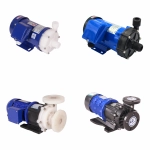
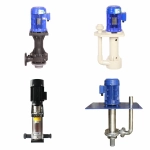
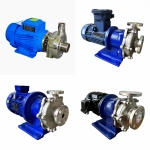
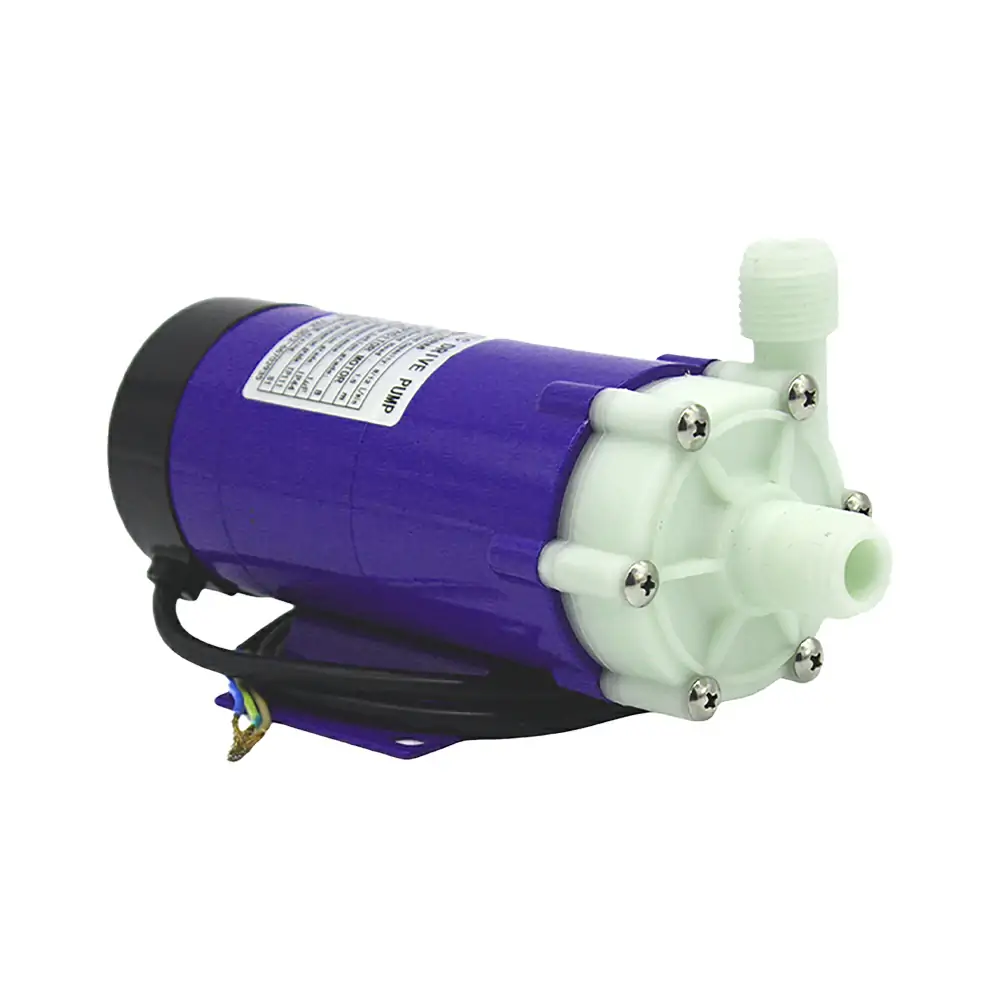
What Is a Magnetic Drive Pump?
A magnetic drive pump (commonly shortened to mag drive pump) is a high-reliability seal-less centrifugal pump that utilizes magnetic coupling technology to transmit power from the electric motor to the internal impeller. Unlike conventional direct-drive pumps that rely on a physical drive shaft and mechanical seals to connect the motor and impeller, mag drive pumps completely eliminate traditional mechanical seal structures. Conventional mechanical seal pumps depend on a thin liquid film to lubricate seal faces during operation, which inevitably carries inherent leakage risks, frequent wear, and short service life.
The core innovation of magnetic drive pumps lies in non-contact magnetic power transmission. Two sets of independent permanent magnet assemblies replace rigid shaft connections, with a sealed containment shell separating the internal fluid chamber from the external motor structure. This design forms a fully hermetically sealed pump body, achieving zero leakage and fundamentally solving the fluid leakage problems that plague traditional sealed pumps.
How Does a Magnetic Drive Pump Work?
Magnetic drive pumps follow the basic operating principle of centrifugal pumps, with unique magnetic coupling power transmission that differentiates them from ordinary centrifugal pumps. The entire working process relies on rotating magnetic fields to transfer torque without any physical contact between driving and driven components, ensuring fully sealed fluid transportation. The complete working cycle can be divided into three systematic stages:
First, power input and magnetic field generation. The electric motor drives the external drive magnet assembly fixed on the motor shaft to rotate at a set speed, generating a stable rotating magnetic field outside the pump’s sealed rear casing.
Second, non-contact torque transmission. The rotating magnetic field penetrates the non-magnetic isolation containment shell and acts on the inner magnet assembly sealed inside the pump chamber. Driven by magnetic force synchronization, the inner magnet and the integrally connected impeller rotate at the exact same speed as the external drive magnet, realizing contactless power transmission.
Third, fluid centrifugal transportation. As the impeller rotates rapidly, liquid enters the pump inlet and flows into the impeller eye. The rotating impeller blades accelerate the liquid, converting rotational kinetic energy into fluid pressure and velocity. The volute casing then collects the high-speed, high-pressure liquid and guides it steadily toward the pump outlet for discharge.
Throughout the entire operation, the containment shell completely isolates the internal pumped fluid from the external environment. With no shaft penetration or mechanical seal gaps, there is zero risk of liquid leakage to the atmosphere, enabling long-term stable sealed operation.
Why Choose a Magnetic Drive Pump?
Thanks to their unique seal-less structure, reliable magnetic transmission performance, and excellent environmental adaptability, magnetic drive pumps have become core fluid transportation equipment for multiple high-standard industries. They are widely applied in chemical manufacturing, wastewater and effluent disposal, brewing and food processing, renewable energy projects, and hazardous medium transportation scenarios. Their outstanding stability and low-failure operation make them increasingly favored in modern industrial production, with continuous expanding market application scope.
Specially engineered plastic magnetic drive pumps stand out in harsh industrial environments, capable of adapting to extreme working conditions including toxic and corrosive media, high temperature and high-pressure operating environments, and flammable and explosive atmospheric scenarios. They deliver stable, safe, and continuous fluid transportation for complex production systems.
Core Advantages of Plastic Magnetic Drive Pumps
Plastic magnetic drive pumps have comprehensive competitive advantages over traditional metal pumps and ordinary sealed pumps in terms of cost, performance, and practicability, with the key benefits summarized as follows:
1. Cost-effective pricing and efficient supply. Plastic materials feature mature processing technology and low manufacturing costs compared to stainless steel and alloy pump bodies. This greatly reduces the end purchase cost for users. Meanwhile, standardized plastic bar and billet raw materials support streamlined production, significantly shortening production cycles and enabling faster order lead times to meet urgent project deployment needs.
2. Superior corrosion resistance and extended service life. High-performance engineering plastics including Polypropylene (PP), PVC, PVDF, and Polyethylene have excellent resistance to acid, alkali, salt, and various chemical corrosive media. They avoid rusting and chemical erosion problems common to metal pumps. With optimized structural design, these pumps operate stably in corrosive working conditions for a long time, effectively extending equipment service life and reducing replacement frequency.
3. Lightweight structure and flexible operation. Engineering plastic materials are far lighter than metal materials, making the overall pump body compact and portable. The lightweight design improves equipment maneuverability, facilitates on-site installation, disassembly, maintenance, and position adjustment, and reduces the labor cost and time cost of equipment operation and maintenance.
4. Mature material performance and strong adaptability. After decades of technological iteration, industrial engineering plastic materials have achieved stable performance and complete specifications. Common materials such as PP, PVC, PVDF, and polyethylene are available in solid bar stock with a maximum diameter of 500mm. PTFE materials can be processed into integral billets, and customized glass-filled or carbon-filled reinforced formulations are available to further enhance structural stability, high-temperature resistance, and mechanical strength, meeting diversified industrial working condition requirements.
5. Low maintenance and high safety. The seal-less design eliminates vulnerable mechanical seal wearing parts, greatly reducing daily maintenance workload and failure rates. The fully sealed structure effectively prevents leakage of toxic, volatile, and flammable media, improving on-site operation safety and environmental compliance.